Enable Ray platform events on Kubernetes#
This guide describes how to enable and use platform events in the Ray dashboard on Kubernetes. Platform events surface Kubernetes lifecycle events for the KubeRay custom resources RayCluster, RayJob, and RayService in the Ray dashboard, alongside your Ray application metrics and logs, so you can correlate cluster behavior with application behavior.
Prerequisites#
Ray version: Ray 2.56.0 or later.
Kubernetes Python client: Install the
kubernetesPython package (pip install kubernetes) in the Ray head pod’s Python environment. The officialrayproject/rayimages don’t include it.Kubernetes cluster: A Kubernetes cluster where you can deploy Ray workloads.
Configure RBAC permissions#
The Ray head pod needs permission to call the Kubernetes API and watch events.
Create a file named ray-rbac.yaml:
apiVersion: rbac.authorization.k8s.io/v1
kind: Role
metadata:
  name: ray-head-watch-role
rules:
- apiGroups: [""]
  resources: ["events"]
  verbs: ["get", "list", "watch"]
- apiGroups: ["ray.io"]
  resources: ["rayclusters"]
  verbs: ["get"]
---
apiVersion: rbac.authorization.k8s.io/v1
kind: RoleBinding
metadata:
  name: ray-head-watch-role-binding
subjects:
- kind: ServiceAccount
  name: default # IMPORTANT: Change this if your Ray Head Pod uses a different ServiceAccount
  namespace: default # IMPORTANT: Change this to the namespace where your Ray cluster runs
roleRef:
  kind: Role
  name: ray-head-watch-role
  apiGroup: rbac.authorization.k8s.io
Apply this configuration to the namespace where your Ray cluster runs:
kubectl apply -f ray-rbac.yaml -n <your-ray-namespace>
The role grants two permissions:
events: Required to stream Kubernetes events.rayclusters: Required for the dashboard to find parent resources such asRayJoborRayServiceand watch their events.
Enable platform events#
Set RAY_DASHBOARD_INGEST_PLATFORM_EVENTS to "true" on the Ray head pod container. This environment variable starts the platform event watcher in the Ray dashboard backend.
For deployments without KubeRay (Ray 2.58+): KubeRay automatically injects RAY_CLUSTER_NAME and RAY_CLUSTER_NAMESPACE into the RayCluster’s Pods. If you deploy Ray on Kubernetes without KubeRay, manually inject these environment variables into your Ray head pod container so the dashboard can display Kubernetes pod events:
env:
  - name: RAY_CLUSTER_NAME
    value: "your-ray-cluster-name" # Must match the target Ray cluster name
  - name: RAY_CLUSTER_NAMESPACE
    value: "your-namespace" # Must match the target namespace
Manifest examples#
Deploy complete working examples from the KubeRay repository:
RayCluster example#
kubectl apply -f https://raw.githubusercontent.com/ray-project/kuberay/master/ray-operator/config/samples/ray-cluster.platform-events.yaml
RayJob example#
kubectl apply -f https://raw.githubusercontent.com/ray-project/kuberay/master/ray-operator/config/samples/ray-job.platform-events.yaml
Verify the configuration#
After you deploy your RayCluster or RayJob with these configurations, complete the following steps.
Port-forward the dashboard#
# Find your Ray head pod
kubectl get pods -n <your-ray-namespace> | grep head

# Port-forward
kubectl port-forward <head-pod-name> -n <your-ray-namespace> 8265:8265
Query the API#
This step is optional. Test the endpoint to confirm that Ray collects events:
curl http://localhost:8265/api/v0/platform_events
A successful response is a JSON object containing recent events:
{
  "result": true,
  "msg": "Retrieved platform events",
  "data": {
    "events": [
      {
        "eventId": "Y2JiMzkxMWQtM2YxZS00YzAwLWFmYWMtN2IxNGU1ZjgwZDZk",
        "sourceType": "CLUSTER_LIFECYCLE",
        "eventType": "PLATFORM_EVENT",
        "timestamp": "2026-06-16T21:49:08Z",
        "severity": "INFO",
        "message": "Created RayCluster default/rayjob-test-f52vq",
        "platformEvent": {
          "source": {
            "platform": "KUBERNETES",
            "component": "rayjob-controller",
            "metadata": {
              "namespace": "default",
              "rayClusterName": "rayjob-test-f52vq"
            }
          },
          "objectKind": "RayJob",
          "objectName": "rayjob-test",
          "message": "Created RayCluster default/rayjob-test-f52vq",
          "reason": "CreatedRayCluster",
          "customFields": {}
        },
        "sessionName": "",
        "nodeId": ""
      },
      {
        "eventId": "MDk1MmYxNzUtY2I3MC00NDU3LWExNzktMTBkYjYwZGZkMDA0",
        "sourceType": "CLUSTER_LIFECYCLE",
        "eventType": "PLATFORM_EVENT",
        "timestamp": "2026-06-16T21:49:08Z",
        "severity": "INFO",
        "message": "Created service default/rayjob-test-f52vq-head-svc",
        "platformEvent": {
          "source": {
            "platform": "KUBERNETES",
            "component": "raycluster-controller",
            "metadata": {
              "namespace": "default",
              "rayClusterName": "rayjob-test-f52vq"
            }
          },
          "objectKind": "RayCluster",
          "objectName": "rayjob-test-f52vq",
          "message": "Created service default/rayjob-test-f52vq-head-svc",
          "reason": "CreatedService",
          "customFields": {}
        },
        "sessionName": "",
        "nodeId": ""
      },
      {
        "eventId": "YTEzMWM1MDQtNWMyNS00NGFkLTkwMmMtNTlmOTQ0ZDFlOGNi",
        "sourceType": "CLUSTER_LIFECYCLE",
        "eventType": "PLATFORM_EVENT",
        "timestamp": "2026-06-16T21:49:08Z",
        "severity": "INFO",
        "message": "Created head Pod default/rayjob-test-f52vq-head-vmlwz",
        "platformEvent": {
          "source": {
            "platform": "KUBERNETES",
            "component": "raycluster-controller",
            "metadata": {
              "namespace": "default",
              "rayClusterName": "rayjob-test-f52vq"
            }
          },
          "objectKind": "RayCluster",
          "objectName": "rayjob-test-f52vq",
          "message": "Created head Pod default/rayjob-test-f52vq-head-vmlwz",
          "reason": "CreatedHeadPod",
          "customFields": {}
        },
        "sessionName": "",
        "nodeId": ""
      },
      {
        "eventId": "NWRhNjhmNmEtYjFhMi00MWZiLWE0YWQtN2IwNjIyNmM1YjAw",
        "sourceType": "CLUSTER_LIFECYCLE",
        "eventType": "PLATFORM_EVENT",
        "timestamp": "2026-06-16T21:49:08Z",
        "severity": "INFO",
        "message": "Created worker Pod default/rayjob-test-f52vq-small-group-worker-j7gtf",
        "platformEvent": {
          "source": {
            "platform": "KUBERNETES",
            "component": "raycluster-controller",
            "metadata": {
              "namespace": "default",
              "rayClusterName": "rayjob-test-f52vq"
            }
          },
          "objectKind": "RayCluster",
          "objectName": "rayjob-test-f52vq",
          "message": "Created worker Pod default/rayjob-test-f52vq-small-group-worker-j7gtf",
          "reason": "CreatedWorkerPod",
          "customFields": {}
        },
        "sessionName": "",
        "nodeId": ""
      }
    ]
  }
}
Check the Ray dashboard#
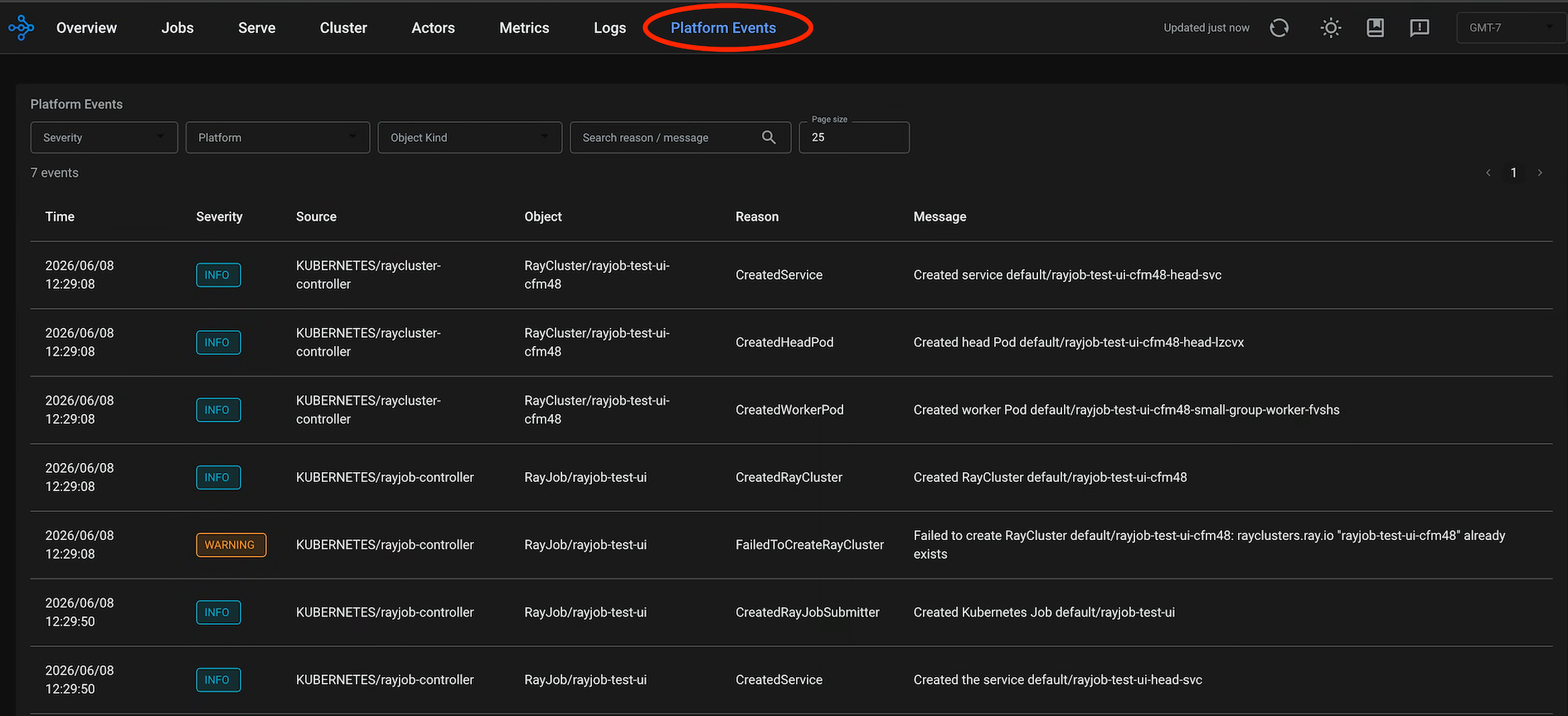
Open http://localhost:8265 in your browser. Look for the Platform Events tab in the navigation bar at the top. The dashboard displays the events there.
Troubleshooting#
Note
In Ray 2.56 and 2.57, this feature tracks only events for the KubeRay custom resources RayCluster, RayJob, and RayService. Starting in Ray 2.58, coverage expands to include generic Kubernetes pod-level events. For non-KubeRay deployments, make sure RAY_CLUSTER_NAME and RAY_CLUSTER_NAMESPACE are manually set on the head pod so pod events appear in the dashboard.
Caution
If the ServiceAccount lacks get permission on rayclusters in the ray.io API group, Ray can’t link events to parent RayJob or RayService resources. The dashboard then shows only the events that target the RayCluster itself.
Route platform events to an external system#
By default, Ray sends platform events to its observability system with the event type PLATFORM_EVENT.
If you set a custom event export address with RAY_DASHBOARD_AGGREGATOR_AGENT_EVENTS_EXPORT_ADDR, you can forward platform events to external logging and monitoring systems. See Ray Event Export.
If you filter event types with RAY_ENABLE_PYTHON_RAY_EVENT_TYPES, include "PLATFORM_EVENT" in the list, for example RAY_ENABLE_PYTHON_RAY_EVENT_TYPES="PLATFORM_EVENT,SYSTEM_EVENT". Otherwise Ray doesn’t export platform events.